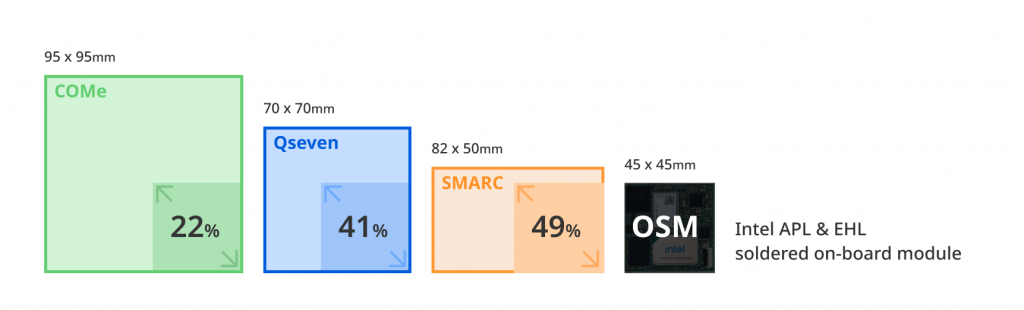
OSM is the smallest industry module standard. Currently, there are three main module form factors, SMARC, Qseven, and COM Express. The size based on OSM-L is 45mm x 45mm, which is only 49% of SMARC, 41% of Qseven and 22% of COM Express. This makes the biggest challenge in developing OSM modules to integrate the full functionality of CISC related chips into an OSM form factor, since CISC chips are typically larger than RISC.
Hardware advantages
Solderable OSM modules provide stamp-sized hardware layout placement and direct-on-board manufacturing. These hardware advantages of OSM allow customers to optimize the architecture of the system design and miniaturize the system form factor.
Optimize the architectural system design
Miniaturize the system form factor
Why customers choose CISC
Not only hardware development, but software resources are also the most important reason why customers choose CISC to build systems. CISC in OSM is an ideal concept with the smallest SoM (System on Modular) in industrial standard and the most popular software development environment. Through the relatively open software architecture, the software development time can be accelerated, the cost of development can be reduced, and a large number of package software can be provided.
Reduce development cost
Provide package software
Accelerate development time
The main goal
Leveraging the CISC ecosystem is the main goal of OSM focusing on IoT products, which can link a wider range of system integration resources, shorten time-to-market and increase market acceptance.
Link
a wider range of system resources
Shorten
time-to-market
Increase market acceptance
The world's first CISC in OSM
Mitwell develops the world’s first OSM integrating CISC software and hardware and provides carrier boards and software packages for customers’ project implementation.